

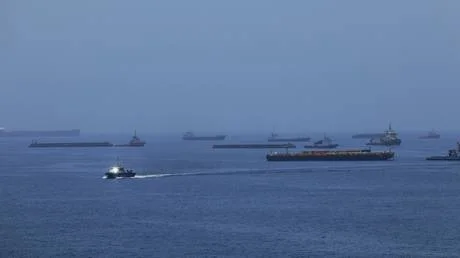
Iran announced an indefinite closure of the Strait of Hormuz to all shipping until the United States ends its "illegal interventions" in the region, according to RT. This decision follows a series of US military strikes against Iran conducted earlier this week.
Tehran’s chief negotiator, Mohammad Ghalibaf, who is also the speaker of the Iranian parliament, emphasized that Iran will not tolerate violations of the June 17 memorandum of understanding (MoU) signed between the two nations. The MoU had allowed commercial vessels to safely pass through the crucial waterway, which handles roughly 20% of the world's crude oil trade, as part of efforts to extend the ceasefire and negotiate a lasting resolution.
In a message posted on X (formerly Twitter) on Sunday, Ghalibaf warned the US that "the era of one-sided deals is OVER," adding, "We told you: keep your word or pay the price. Reality is knocking." His post included a screenshot highlighting Tehran's commitment under the MoU to ensure the safe passage of commercial ships through the Strait.

The US Central Command (CENTCOM) justified its recent airstrikes by accusing Iran of a "blatant" assault on the Cyprus-flagged container ship GFS Galaxy in the Strait of Hormuz. However, the Islamic Revolutionary Guard Corps (IRGC) argues that it targets commercial vessels navigating a shipping lane near the Omani coast, which Washington has unilaterally designated, rather than the route mapped by Tehran.
In retaliation for the US attacks, Iran launched drone and missile strikes against American military installations in Jordan, Kuwait, Bahrain, and Oman. The IRGC reported hitting a command center and hangars housing US MQ-9 Reaper drones at Prince Hassan Air Base in Jordan, as well as a refueling facility for US aircraft carriers at the port of Duqm in Oman.
Issuing a stern warning, the IRGC stated, "The enemy should know that the continuation of its aggression will bring even more crushing responses. Bring it on, and we will fight back."
Why this matters
The Strait of Hormuz is a vital chokepoint for global oil shipments, and its closure could severely disrupt international energy markets. Iran's firm stance signals escalating tensions that risk broader regional instability and complicate diplomatic efforts to resolve ongoing conflicts in the Middle East.
As the US and Iran trade military actions and warnings, the potential for further escalation remains high, making the situation critical for global security and economic stability.