

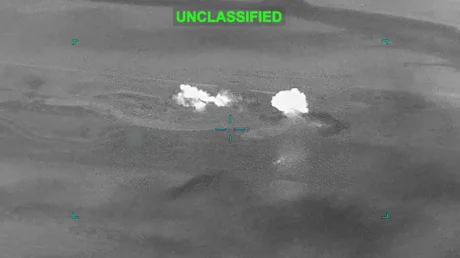
The United States initiated a fourth series of military strikes against Iran on Sunday, targeting key Iranian military installations in response to attacks on commercial vessels navigating the Strait of Hormuz. According to RT, US Central Command (CENTCOM) announced that these actions aim to weaken Tehran's capacity to threaten maritime traffic in this crucial waterway.
CENTCOM revealed on social media that the strikes began around 5 p.m. ET, focusing on degrading Iran's ability to freely assault civilian mariners and commercial ships. The US military targeted numerous Iranian assets, including air defense systems, radar sites, drone and missile facilities, and naval vessels, marking an escalation in the ongoing conflict.
Iranian state media reported significant explosions in southern Iran, particularly in port cities such as Bandar Abbas, Sirik, and Jask, as well as on Qeshm Island. Additionally, at least eight towns in the Khuzestan province, which borders Iraq, were reportedly hit during the operations.

In retaliation, Iran condemned the US strikes as "war crimes," per the Iranian Foreign Ministry statement carried by Press TV. Iran responded by launching missile attacks on Bahrain, prompting air raid sirens in the region. Observers noted smoke rising from the US Navy’s Fifth Fleet headquarters and Isa Air Base. Furthermore, Iran’s Islamic Revolutionary Guard Corps (IRGC) claimed to have destroyed a Patriot missile defense system at Kuwait's Ali Al Salem Air Base and a radar installation at Ahmad al-Jaber Air Base.
The IRGC reiterated its stance from Saturday, declaring that the Strait of Hormuz would remain closed to all shipping until the US ceases what Iran calls "illegal interventions" in the Middle East. Iran’s chief negotiator, Mohammad Bagher Ghalibaf, criticized "one-sided agreements" and warned the US to honor its commitments or face consequences.
Over the prior three nights, US forces struck over 300 Iranian military targets, according to CENTCOM. Iran responded by firing missiles at five Gulf Arab nations housing American military bases, intensifying regional tensions.
The core dispute lies in the interpretation of the June 17 memorandum of understanding (MoU) between the US and Iran regarding maritime passage through the Strait of Hormuz, a vital corridor responsible for roughly 25% of global seaborne oil and LNG shipments. Iran agreed to ensure safe passage for commercial vessels without charging fees for 60 days and to negotiate future maritime administration with Oman.
Nonetheless, Iran insists on its right to regulate traffic and impose tolls, demanding ships adhere to designated routes. The US counters this by insisting the strait remain fully open and has been guiding vessels along a passage near the Omani coast, which the IRGC has labeled "illegal."
Why this matters
The Strait of Hormuz is a strategic chokepoint for global energy supplies, making stability in the region critical to international markets. Continued military confrontations risk disrupting vital oil and gas exports, potentially leading to increased global energy prices and heightened geopolitical instability. This ongoing US-Iran confrontation could further complicate diplomatic efforts in the Middle East.
As both sides escalate military actions and rhetoric, the risk of broader conflict grows, emphasizing the need for renewed dialogue and adherence to international maritime laws.